Exposing Openshift API server
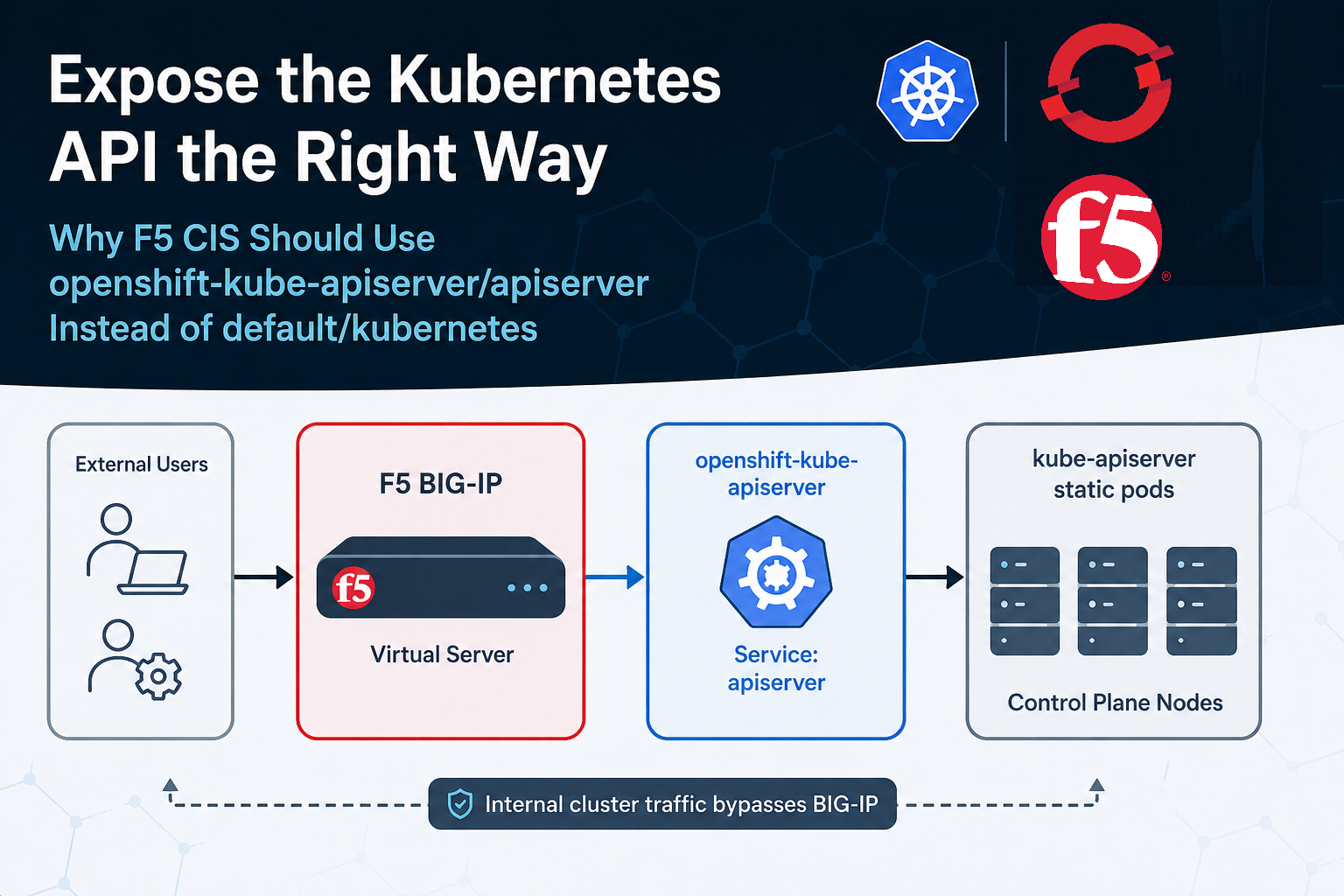
When integrating F5 CIS with OpenShift, a common requirement is exposing internal ClusterIP services externally through BIG-IP virtual servers. For most services, CIS works exactly as expected, however, the Kubernetes API server is special.
The Two API Services in OpenShift
OpenShift exposes the Kubernetes API server through two Services:
| Service | Namespace | Purpose |
|---|---|---|
kubernetes |
default |
Standard upstream Kubernetes API access |
apiserver |
openshift-kube-apiserver |
OpenShift infrastructure/operator access |
Both ultimately reach the same kube-apiserver instances running on control plane nodes.
The implementation details, however, are very different.
The default/kubernetes Service Is Special
The upstream kubernetes.default.svc does not use selectors.
You can verify this:
1
oc get svc kubernetes -n default -o yaml
Notice there is no selector:
1
2
3
4
5
spec:
  clusterIP: 172.30.0.1
  ports:
  - port: 443
    targetPort: 6443
This Service exists to solve a bootstrap problem:
How can workloads reliably discover the API server before normal Kubernetes controllers are fully operational?
As explained in this excellent article from NetworkOP]:
“…the endpoints for default/kubernetes are populated through special internal reconciliation logic rather than standard selector-based endpoint management.”
Why This Matters for F5 CIS
F5 CIS expects Kubernetes Services to behave conventionally:
1
2
3
4
5
Service
  -> Selector
     -> Pods
        -> EndpointSlices
           -> BIG-IP Pool Members
This works perfectly for most application workloads. However, default/kubernetes breaks several assumptions:
- no selector
- manually managed endpoints
- special reconciliation behavior
- not intended for generic ingress exposure
The issue is not that the Service lacks endpoints. The issue is that the Service was never designed to function as a standard externally exposed Service.
OpenShift Provides a Better Alternative
OpenShift introduces: openshift-kube-apiserver/apiserver
Unlike default/kubernetes, this Service behaves much more like a standard Kubernetes Service. Inspect it:
1
oc get svc apiserver -n openshift-kube-apiserver -o yaml
You will typically observe:
- selector-backed behavior
- standard EndpointSlice reconciliation
- integration with OpenShift service CA management
This makes it far more compatible with CIS.
Important Clarification
The kube-apiserver instances are still static control-plane pods managed by the cluster-kube-apiserver-operator.
This is not a normal Deployment. The distinction is not about the backend pods themselves. The distinction is about:
- how the Services are reconciled
- how endpoints are managed
- which consumers are expected to use them
We Do Not Want Internal API Traffic Through BIG-IP
BIG-IP should not sit in the middle of Kubernetes east-west control-plane traffic. The goal is only to expose the API externally.
Recommended model:
| Traffic Type | Path |
|---|---|
| Internal cluster traffic | Native cluster networking |
| kubelet -> apiserver | Native networking |
| operator -> apiserver | Native networking |
| External admin/API access | BIG-IP |
| External console access | BIG-IP |
BIG-IP is excellent for:
- external HA
- TLS termination
- WAF
- external load balancing
…but internal control-plane communication should remain native.
Recommended Architecture
1
2
3
4
5
6
7
8
9
10
11
12
13
14
15
16
17
18
19
20
21
External Users
        |
        v
+-------------------+
|     F5 BIG-IP     |
|  Virtual Server   |
+-------------------+
        |
        v
+-------------------------------+
| openshift-kube-apiserver      |
| Service: apiserver            |
+-------------------------------+
        |
        v
+-------------------------------+
| kube-apiserver static pods    |
| on control plane nodes        |
+-------------------------------+

Internal cluster traffic bypasses BIG-IP
Final Thoughts
The default/kubernetes Service is one of Kubernetes’ oldest and most specialized abstractions. It exists primarily for bootstrap reliability and universal API discovery.
It was not designed as a generic ingress target.
When exposing the Kubernetes API externally through F5 CIS, the better option in OpenShift is usually:
1
openshift-kube-apiserver/apiserver
This allows BIG-IP and CIS to interact with a more conventional Service abstraction while keeping internal control-plane communication native to the cluster network.